
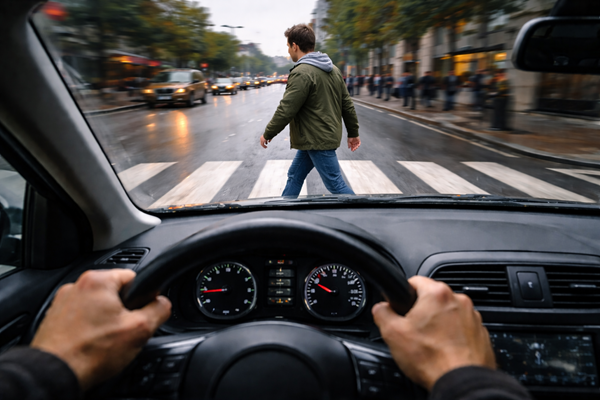
March is Brain Injury Awareness Month, a time to reflect on the dangers pedestrians face every day across NYC. Pedestrians don't get a crumple zone. No seatbelt, no airbag, no steel frame absorbing the energy before it reaches the body. When a vehicle and a person collide, the physics are unforgiving, and the head, sitting atop a flexible neck with nothing to brace it, tends to bear the worst of what follows.
What most people don't realize is that serious head trauma in a pedestrian accident rarely comes from a single, obvious blow. It comes from a sequence of impacts, some expected, some not, and from forces that damage the brain without leaving a mark on the outside. Understanding how that process works matters because the injuries that go unrecognized in the first hours after a crash are often the ones that cause the most lasting harm.
Why are pedestrians so uniquely vulnerable to head injuries in a collision?
The core problem is asymmetry. A vehicle weighing several thousand pounds transfers an enormous amount of force into a body weighing a fraction of that, with nothing in between to absorb or redirect it. But what makes pedestrian collisions particularly dangerous for the brain is not just the force involved. It's the sequence of events that force sets in motion.
When a vehicle strikes a pedestrian, the body doesn't simply fall straight down. It goes through a predictable multi-phase progression that can produce separate, distinct injuries at each stage:
- The initial strike, typically to the lower body, causes the upper torso to rotate sharply toward the vehicle due to the sudden transfer of momentum.
- Secondary impact with the vehicle, where the upper body, and often the head, strikes the hood, windshield, or roof, depending on the vehicle's height and speed.
- The airborne phase, in higher-speed collisions, where the pedestrian is launched away from the vehicle entirely before the final impact.
- Ground impact, often to the back or side of the skull, which frequently delivers the single most damaging blow in the entire sequence.
That final ground impact is the one that is most often underestimated. By the time a pedestrian reaches the pavement, they may have already absorbed two or three separate force events. The cumulative effect on the brain, even when no single impact looks catastrophic from the outside, is what produces the serious injuries that follow.
What types of head injuries are most common in pedestrian accidents?
Pedestrian collisions produce a range of brain injuries, and the most serious ones aren't always the most visible. Common injuries include:
- Concussion, the most frequent result, is caused by the brain shifting inside the skull on impact.
- Subdural hematoma, a slow bleed between the brain and skull that can expand for hours before symptoms appear.
- Epidural hematoma, a faster-moving arterial bleed that can become life-threatening within minutes.
- Diffuse axonal injury, caused by rotational forces that shear the nerve fibers connecting brain regions, often invisible on standard CT scans.
- Skull fractures, which can drive bone fragments into brain tissue and are common in direct ground impacts.
Who is legally responsible when a pedestrian suffers a head injury?
Pedestrian accident liability generally comes down to proving that a driver failed to exercise reasonable care and that failure directly caused the pedestrian's injuries. The most common forms of driver negligence in these cases include:
- Distracted driving, including phone use, which significantly reduces a driver's ability to detect and respond to pedestrians in crosswalks or at intersections.
- Failure to yield, particularly at marked crosswalks and intersections where pedestrians have the legal right-of-way.
- Speeding in pedestrian zones, which both increases the likelihood of a collision and dramatically worsens the severity of injuries if one occurs.
- Impaired driving, whether from alcohol, drugs, or prescription medications, which reduces reaction time and situational awareness in environments where pedestrians are present.
- Running red lights or stop signs, which eliminates the brief moment of warning that might otherwise allow a pedestrian to react.
One thing worth understanding is how insurance companies respond to these claims. Insurance companies often attempt to assign partial fault to the pedestrian, arguing they were jaywalking, wearing dark clothing at night, or not paying attention to traffic. In states that follow a comparative fault framework, this tactic is designed to reduce the payout rather than reflect an honest accounting of what happened. An experienced attorney can challenge that narrative with traffic camera footage, witness statements, and accident reconstruction evidence.
A head injury changes everything. Giampa Law can help you seek justice.
A pedestrian head injury is not a minor inconvenience with a straightforward recovery. It's a medical, financial, and personal crisis that can unfold over months or years, and the insurance company representing the driver who hit you is already working to pay you as little as possible. Giampa Law has spent decades fighting back on behalf of injured pedestrians across the Bronx, all five boroughs of New York City, and Westchester County. We've recovered millions of dollars for clients who were told their cases weren't worth much. That includes a $1.5 million verdict and a $1.3 million settlement for Bronx pedestrian accident victims alone.
Getting started is simple, and it costs you nothing. Our consultations are completely free, and we work on a contingency fee basis, which means you pay no attorney's fees upfront. We also understand that a serious head injury can make it impossible to come to us, so we'll come to you. Whether you're at home recovering or still in a hospital room, our team will meet you where you are.
If you suffered a head injury in a pedestrian accident anywhere in New York City or Westchester County, don't wait for the insurance company to set the terms. Contact us online or call today to schedule your free case evaluation and find out exactly what your case is worth.
"Richard and Zach guided me through my accident case from my employer denying my work-related vehicle injury through 2 surgeries. They were always there asking if I was ok and if I needed help with anything. They were able to get me the settlement I deserved. I couldn’t be happier. I highly recommend them; they care about clients more than just financially." – J.L., ⭐⭐⭐⭐⭐